Secure Home During Blackouts
A neighborhood blackout removes the ordinary signals that tell you a street is active. The first ten minutes should follow a written routine, not impulse.
How we reviewed this
Reviewed editorially from public vendor information; no hands-on testing claimed.
Quick answer
- Account for people first
- Use one low-power lamp
- Call at a written threshold
The problem
A neighborhood blackout changes the information you have. Streetlights vanish, cameras may go offline, and the ordinary sounds that tell you a place is busy disappear. The goal is not to turn your home into a fortress. It is to keep your household calm, make entry harder, and preserve a way to call for help. Most mistakes in the first ten minutes come from rushing: people open every curtain, charge every phone at once, or send a vague message to a group chat. A short, agreed routine prevents those scattered decisions and gives everyone a job. Blackouts also change behaviour inside the house. People open doors to check the street, leave phones charging on every surface, and gather at windows where they can be seen. A routine gives those impulses somewhere to go: one lamp, one check, one message, then wait. Write the routine on the inside of the kit lid. In an outage, nobody wants to remember a sequence they read last month.
Step-by-step
- Account for people first: Confirm everyone is inside and unhurt before touching security gear. Panic causes more injuries than intruders. Make this a single call-out rather than a search; everyone should know the one place to gather.
- Switch to controlled light: Use one battery lamp in a common room. Avoid lighting every window, which reveals occupancy and burns batteries. Low, directed light lets you move safely without turning the house into a display.
- Check entry points once: Lock and brace doors and sliding panels, then stop. Repeated checking wastes time and increases anxiety. One slow pass with a lamp is enough; after that, trust the work you did.
- Preserve communications: Keep phones on low-power mode, use text rather than calls, and confirm your neighbour check-in plan. Agree on a simple phrase that means "we are fine" so nobody has to write a long message in the dark.
- Decide when to call: Set a threshold for calling authorities: active entry, threats, or a person you do not recognize trying doors. Decide this before the outage, because a threshold you invent at 2 a.m. will be too vague to use.
Where a product fits
A bundled kit can speed up step three if the pieces fit your doors. Keep it near the entry points and practice installing it once a year. The plan and the lights matter more than the brand. If your neighbours also have a basic kit, compare notes; you may discover that one of you has a brace that fits a shared style of door and the other does not. After the outage, review what actually happened and change one item. Maybe the lamp was too dim or the neighbour text was never sent. A ten-minute review the next morning is what turns a kit into a plan that improves. After each drill, change one line of the written routine. A plan that survives contact with a real blackout is edited, not memorised.
Verdict
Decide the call threshold before the outage. One lamp, one entry check and one text tree are more useful than searching every window.
Frequently asked questions
What is the first thing to do when the street goes dark?
Account for household members, switch on one low-power light, and check entry points before looking at screens. Phones are useful, but they are not the first tool when everyone is disoriented. Do not count a call to a family member as the emergency call; keep the two lists separate.
Should I announce I am home?
Avoid broadcasting your status online or to a wide group. Keep normal lights low and use controlled indoor lighting. A house that looks occupied is better than one that advertises an empty schedule. If a neighbour is unresponsive, leave a note rather than entering their home alone. A quick wave from a window is enough; no long conversation in the dark.
How do neighbours help?
Agree in advance on a check-in method and a safe meeting point. A short text tree is more reliable than shouting across a dark street, and it leaves a record of who has checked in. Use the same phrase every time so the check-in takes seconds.
When should I call authorities?
If you see active entry, threats, or suspicious groups testing doors, call emergency services. Do not confront anyone alone. Your job is to keep your household safe and report clearly, not to investigate.
Back to Home Security & Preparedness
Keep reading
Related offer
Anti-Looter Kit - BRAND NEW!
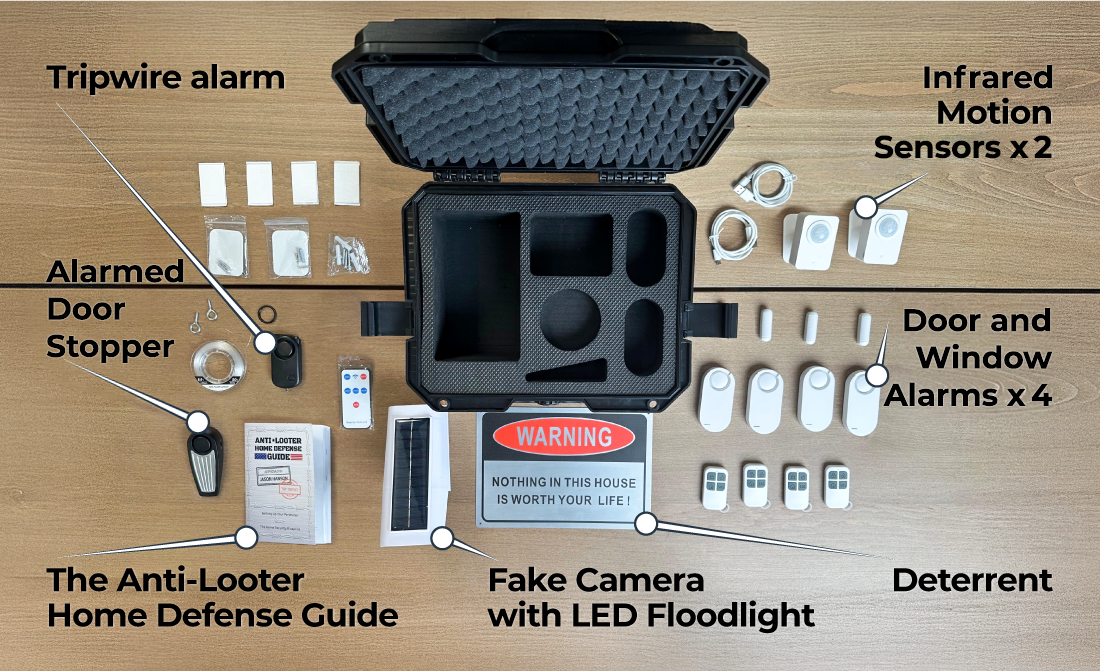 Explore Anti-Looter Kit - BRAND NEW!