Home Security Emergency Kit Checklist
Most kits fail because they are assembled once and never opened again. A dated checklist turns the idea into named items you can inspect twice a year.
How we reviewed this
Reviewed editorially from public vendor information; no hands-on testing claimed.
Quick answer
- Entry barriers
- Two battery lights
- Dated review and contacts
The problem
Most emergency kits fail because they are assembled in a hurry and never opened again. A checklist fixes that. It turns a vague idea of preparedness into named items you can inspect twice a year. The list below focuses on security during loss of power, not on survival stockpiling. It assumes you already have working locks and a way to call for help. If those basics are weak, fix them before adding another gadget. A short checklist you can recite from memory is more useful than a long one stored in a file you never open. Another common failure is storing the kit somewhere clever. A locked drawer behind a cupboard is secure in daylight and useless at midnight. Choose a place that is protected from children but reachable by adults without a light, and tell those adults where it is. Give each item a fixed home in the box. Preparedness fails less often because gear is missing than because it is somewhere else.
Step-by-step
- Entry barriers: Door brace, sliding-door lock, and window stops. Measure before buying and practice installation in daylight. Check that each item can be removed from inside in seconds, because a barrier that traps you is a hazard.
- Light you control: Two battery lanterns plus spare cells. Store them in the same place as the barriers. Test them on low brightness, since that is the setting you will actually use during a long night.
- Power for small devices: A charged power bank and short cable. Label it for emergency use only. A cable that lives with the kit is better than one you have to hunt for in three different rooms.
- Alert and communication: A simple motion alert or whistle, plus a written contact sheet with neighbours and family. Decide who sends the first message and who calls emergency services if needed.
- Review date: Write the next check date on the box. Test each item and rotate batteries on that date. A dated box is a working kit; an undated box is a collection of guesses.
Where a product fits
If the checklist feels like too many separate purchases, a bundled kit such as the Anti-Looter Kit can provide a starting set. Use the checklist to verify what is actually included; do not assume the bundle covers every category. Whatever you buy, add the review date and the one-page contact sheet yourself. Those two items cost almost nothing and do more for readiness than an extra gadget you have not practiced using. Once the kit is assembled, run a timed drill: in under two minutes, an adult should be able to find the lamp, brace one door, and locate the contact sheet without switching on a mains light. If that fails, simplify the storage rather than buying more. A bundle is acceptable only after you have crossed off every category on your own list.
Verdict
A bundle can supply the starting pieces, but you still need the review date and the paper contact sheet. A ten-minute drill is the real test.
Frequently asked questions
How often should I rotate batteries?
Twice a year is a simple rule. Test each light during the rotation so you never discover a dead cell in an outage. Pair the check with a calendar event you already use, such as a clock change. Use the same day twice a year so the habit sticks.
Do I need a fire-egress plan?
Yes. Every barrier must be removable quickly from the inside. Never block an exit path, and make sure every adult knows how to release each brace without light. Practise releasing each barrier with your eyes closed once, then open them; the motion should be obvious. A second adult should be able to repeat the same check without asking.
Should children know where the kit is?
Adults should know the location. Teach older children what the kit is for without encouraging them to handle barriers. A clear rule about gathering in one room is more useful to them than hardware details. Older children can learn the gathering place and the phone number, not the hardware.
What document should I include?
A one-page sheet with emergency contacts, neighbour numbers, and the location of spare keys or chargers. Keep it in the same box as the lights, because paper works when your phone does not. Laminate the sheet if the kit lives somewhere damp. Keep the sheet where you keep the lamp, not in a phone app.
Back to Home Security & Preparedness
Keep reading
Related offer
Anti-Looter Kit - BRAND NEW!
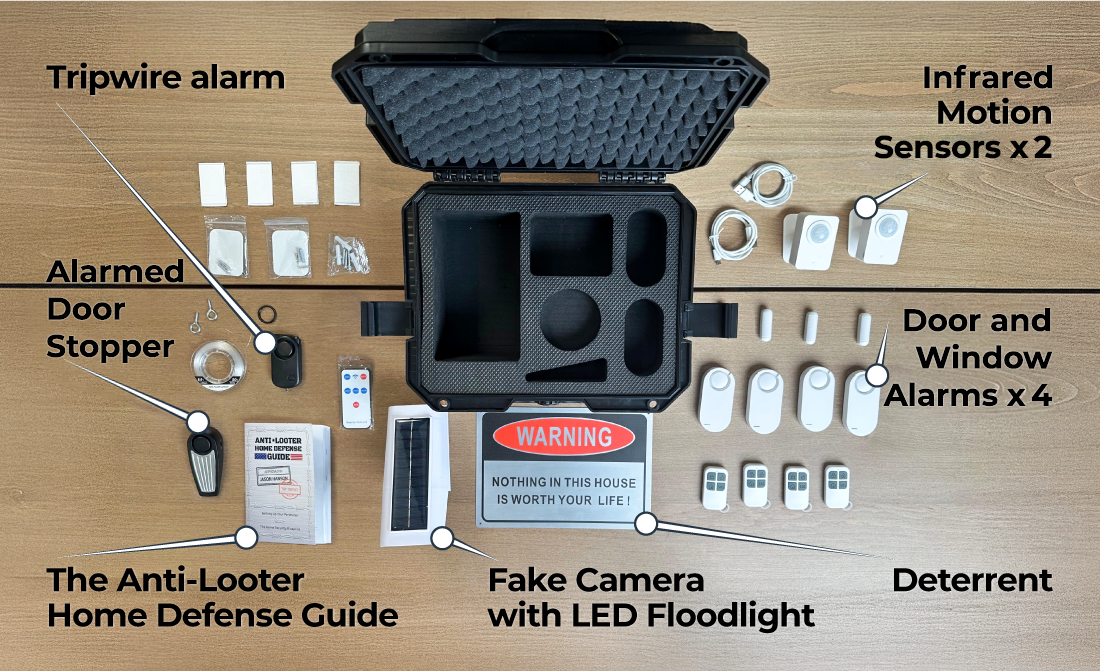 Explore Anti-Looter Kit - BRAND NEW!