Home Security Alerts in Blackouts
An outage alert has one job: tell you that something changed at an entry point without depending on the grid. Complexity and false alarms are its enemies.
How we reviewed this
Reviewed editorially from public vendor information; no hands-on testing claimed.
Quick answer
- Avoid router-dependent devices
- Assign a responder
- Drill monthly
The problem
An alert system during an extended blackout has one job: tell you that something changed at an entry point, without depending on the grid. That is narrower than a full security system, and it is easier to build. The two failure modes are devices that need Wi-Fi and alerts nobody knows how to respond to. A third, quieter failure is false alarms. If a sensor triggers every time a branch moves, people stop reacting, and the system becomes decoration. Design for the boring case: one clear signal, one clear responder, and one clear action. A third failure is complexity. A system with six sensors and three apps is hard to explain to the person who might need it at 2 a.m. Keep one signal, one responder, and one action. That constraint feels limiting on paper and liberating in practice. Write the response rule before you buy the sensor. A device is only useful if the decision after it beeps is already made.
Step-by-step
- Choose local alerts: Use battery motion sensors, door contacts, or a whistle that does not need a router. Verify what happens when power drops. A device with a glowing app but no offline behaviour is not part of this plan.
- Cover entry points only: Front door, side door, and ground-floor windows. More sensors mean more false alarms and more battery changes. Three reliable alerts beat eight you have to silence every morning.
- Assign a response: Write down who checks the alert and who calls emergency services. No ambiguity at 2 a.m. Include a fallback if the first person is asleep or away.
- Pair with light: Keep a shielded lantern next to the alert location so verification does not require wandering in the dark. The light should be reachable from a safe room, not stored behind the door you are worried about.
- Run a monthly drill: Trigger the alert, follow the written response, and note the battery level. Fix one thing each time. A drill that takes two minutes is easy to repeat, which is the whole point.
Where a product fits
A kit with a basic alert and portable light can cover the first two steps. Add extra sensors only after a month of clean, low-false-alarm operation. Keep the response sheet with the kit, not on a phone that may be flat. If a monthly drill shows that the alert is unreliable, remove it rather than compensating with more gadgets; a smaller system you trust is safer than a larger one you keep questioning. After a month, check whether you still trust the alert. If you have silenced it more than once, remove or reposition it. A smaller system that you believe is far more useful than a larger one you keep doubting. If an alert wakes the whole house for a branch moving outside, move it or remove it; trust matters more than coverage.
Verdict
Keep one signal, one responder and one action. Remove any sensor you have silenced more than once; trust matters more than coverage.
Frequently asked questions
Do Wi-Fi cameras count as an alert system?
Only when the router and power are up. For outages, use local motion alerts, whistles, or a cellular backup. Test with the router unplugged before you treat any device as part of the plan. Write down which devices survived the router test and put that list with the kit. A label on the device is enough; an app is not.
How do I avoid false alarms?
Aim sensors at entry points, not walkways with moving branches or pets, and test during daylight. A sensor that cries wolf every night will be ignored exactly when it matters. Test at the same time of day you would normally be asleep; daytime sensitivity is misleading.
Who should respond to an alert?
A designated adult. Agree in advance that you will verify visually from a safe position and call authorities rather than confront anyone. Write the rule down so it does not depend on who happens to be awake. Practise the phrase you will use when you call: address, what you saw, and whether anyone is inside.
How often should I test?
Monthly, using the same routine you would use at night. A test that is never repeated is not a plan. Record the date and any battery level you checked. Rotate the test battery on the same day you check smoke alarms.
Back to Home Security & Preparedness
Keep reading
Related offer
Anti-Looter Kit - BRAND NEW!
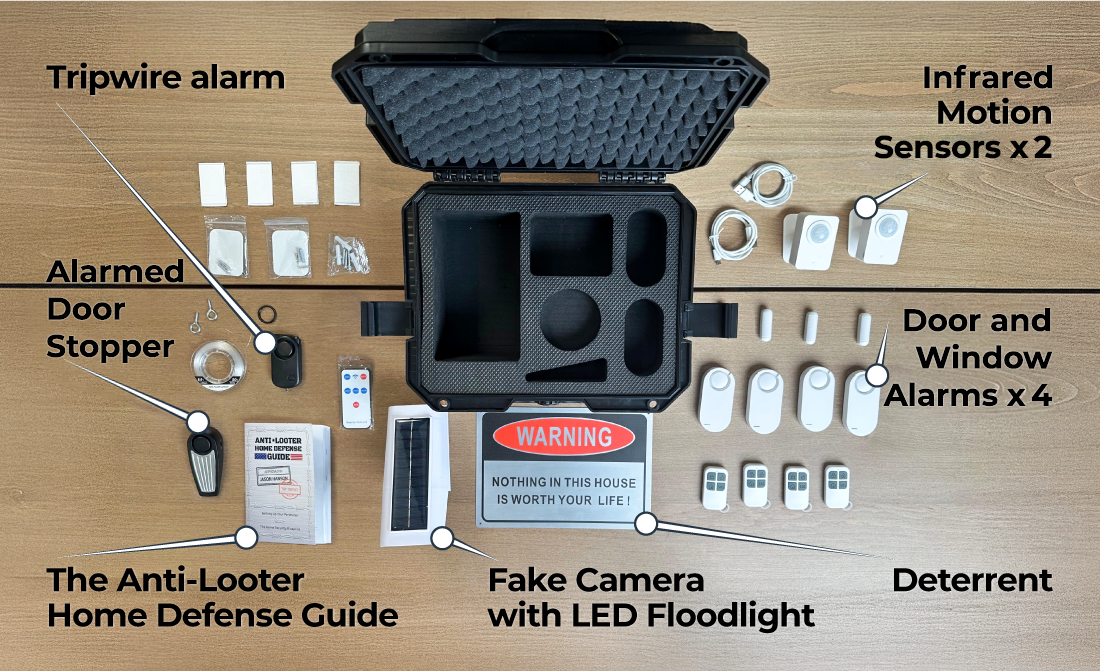 Explore Anti-Looter Kit - BRAND NEW!