Best Home Defense Kit for Outages
The best kit for an outage is the one you can find and use in the dark. Start with doors, windows, light and communications before adding electronics.
How we reviewed this
Reviewed editorially from public vendor information; no hands-on testing claimed.
Quick answer
- Barriers and light come first
- Add cameras later if at all
- Assign two named owners
What it is
A home defense kit for power outages is less about confrontation and more about delaying unwanted entry while keeping your household oriented. The core categories are simple: barriers for doors and windows, light you control, power for small devices, and a way to be alerted to movement. The best kit is the one you have practiced installing before you need it. Buying more gear does not fix uncertainty; a written inventory and one rehearsal do. Think of the kit as a set of answers to predictable problems: the hallway is dark, the sliding door is easy to move, and nobody knows who should call for help. Each item should map to one of those problems.
Pros and cons
What works
- Physical barriers do not depend on electricity and keep working when the router and alarm panel are offline.
- Battery light reduces the confusion that follows a sudden blackout and makes a room feel navigable again.
- A written plan prevents everyone from searching for phones and chargers at the same time.
- Modular kits are easy to expand one category at a time as your local risk becomes clearer.
Limits
- Over-buying creates clutter without improving readiness, especially when several items solve the same problem.
- Batteries expire and must be rotated; an untested light is not part of a working kit.
- No kit substitutes for decent locks, outside lighting, or neighbours who agree to look out for one another.
Price, guarantee, and who it is for
Price: Set a budget before shopping. A basic starter kit can be assembled around a door brace, a sliding-door lock, two lights, and spare cells. Spend first on barriers and light; add cameras or alarms only after the basics are in place. A sensible rule is to buy one complete solution per entry point before buying a second gadget for the same room. That keeps the kit understandable when you need to use it quickly. If the budget allows only one upgrade, add a second reliable light before adding a camera; visibility prevents more mistakes than a screen does.
Guarantee: Check return terms and compatibility before buying any bundled kit. A product that does not fit your doors is useless, regardless of how positive the reviews are. Test each piece on arrival, keep the packaging until you know it fits, and note the return deadline on your calendar rather than trusting yourself to remember.
Households in storm-prone areas, people who work odd hours, and anyone who wants a calm, written outage routine. Skip aggressive add-ons if you have not practiced the basics. If you live in a building with a manager or shared security, coordinate with them first so your barriers do not conflict with building rules or fire exits.
Verdict
Keep it small and tested. Two adults should know where it is, and every barrier must release quickly from inside. That routine beats extra gear.
Frequently asked questions
What belongs in a power-outage security kit?
Door and window barriers, portable lighting, spare batteries, a charged power bank, a basic alert, and a written contact plan. Keep the list short enough that you can check it in two minutes. Keep the list on paper inside the kit, not only on a phone.
Should I include weapons?
This guide focuses on barriers, lighting, and awareness. Any defensive tool carries legal and safety responsibilities, and training matters more than ownership. If you include anything of that kind, know the law where you live and store it safely.
How long should supplies last?
Prepare for at least three days of reduced light and charging, then expand based on your local outage history. Batteries are the usual limiting factor, not the number of barriers.
Where should I store it?
In a locked, accessible place known to adults in the household, not in a sealed closet you cannot reach in the dark. Check that every barrier can be removed quickly from the inside.
Back to Home Security & Preparedness
Keep reading
Related offer
Anti-Looter Kit - BRAND NEW!
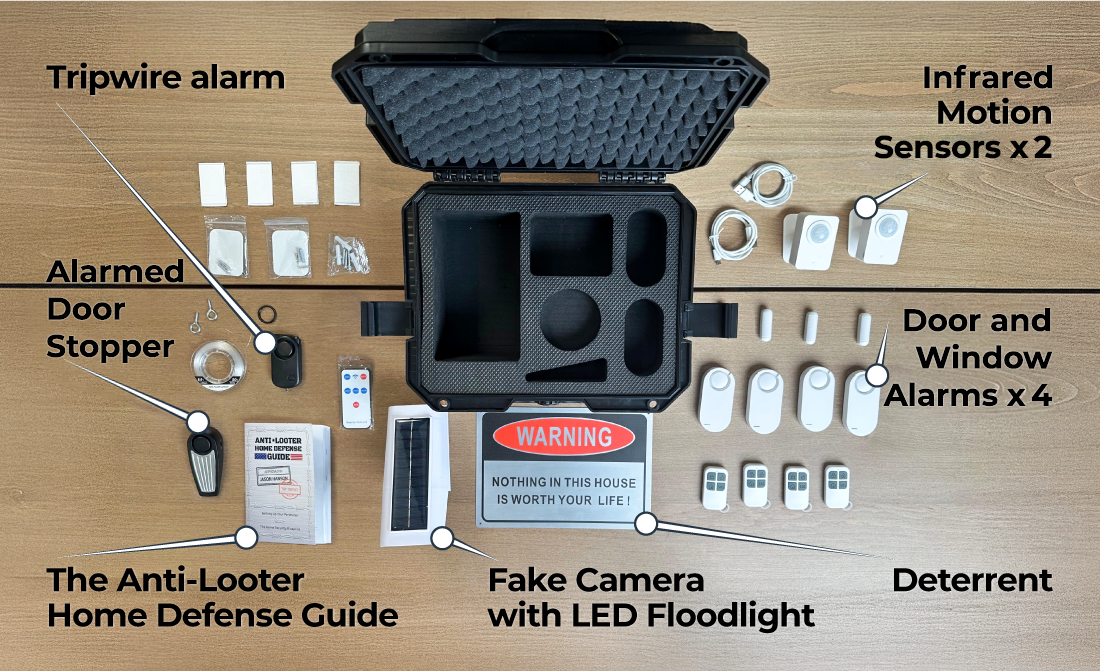 Explore Anti-Looter Kit - BRAND NEW!